Airport guide
Dublin Airport (DUB, EIDW) at a glance
Dublin Airport is Ireland’s busiest airport, with a record 33.3 million passengers in 2024. It is owned by daa plc, a State-owned company, and lies 10 km (5.4 nautical miles) north of Dublin. It was first known as Collinstown Airport.
Aircraft
What can fly from Dublin Airport
Charter-A is a charter broker: we arrange private jet and air taxi flights to and from Dublin Airport, and helicopter flights where the airport’s rules allow. Here is what each one means at this airport.
Private jets at Dublin Airport
Three hard runways, the longest 3,109 m, take private jets of every size, from light jets to long-range aircraft. Dublin is a slot-coordinated airport and handling is compulsory, so the handler arranges the airport slot for your flight. Passengers are normally handled through the general aviation facilities or a private terminal (FBO), and arrive about 30 minutes before departure.
Air taxis at Dublin Airport
Turboprops use the same runways as the jets, under the same slot and handling rules. Only jet fuel is published as available at Dublin Airport, with no fuel for piston engines, so the smallest piston aircraft are better suited to Weston Airport, west of the city. Passengers arrive about 30 minutes before departure.
Helicopters at Dublin Airport
Helicopters are restricted here. They are not permitted unless prior approval has been granted, and the flight must come from an aerodrome that meets the airport’s security rule. There is no helipad: a helicopter lands on a runway. A transfer from a private site straight into the airport should not be counted on, and we will say so before you book. For an approved flight, passengers arrive about 10 minutes before departure.
Airport facts
Dublin Airport facts, codes and location
The reference details for Dublin Airport, with the airfield on a satellite map. The rings are 1,000 and 2,000 metres from the airport reference point, the middle of the south runway.
| Address | Dublin Airport, Swords, Co. Dublin, K67 X4X5, Ireland |
| ICAO code | EIDW |
| IATA code | DUB |
| Coordinates | 53.4214 N, 6.2700 W |
| Elevation | 243 feet (74 m) |
| Runways | 10R/28L: 2,637 m, asphalt. 10L/28R (North Runway): 3,109 m, concrete. 16/34: 2,072 m, asphalt. All 45 m wide and grooved |
| Owner | daa plc, a State-owned commercial company with its head office at the airport |
| Opening hours | 24 hours. Closed on 25 December. Slot-coordinated airport |
| Customs and immigration | Available 24 hours |
| Handling | Compulsory for every aircraft |
Dublin Airport (DUB, EIDW) is at 53.4214 N, 6.2700 W. The facts table on this page gives the address, codes and runway.
Dublin Airport (DUB, EIDW) is at 53.4214 N, 6.2700 W. The facts table on this page gives the address, codes and runway.
Private terminals
Private terminals and handlers at Dublin Airport
Two corporate handlers (FBOs) are named for private flights at Dublin Airport. The airport also has its own private terminal, Platinum VIP, beside Terminal 1, which is open to private flights.
Signature Aviation at Dublin Airport
AddressT1x, Terminal 1, Dublin Airport, Collinstown, K67 X4X5, Ireland
Hours06:00 to 22:00 local time, call-out available on request
Corporate and general aviation handling, with customs and immigration on site, a passenger lounge and a crew lounge.
Universal Aviation at Dublin Airport
AddressCorballis Park, Toberbunny, Dublin Airport, Dublin, Ireland
Hours07:00 to 22:00, 24 hours on request
Corporate and general aviation handling, with an office on the public side of the airport.
The handler meets you, checks passports where the flight needs it, looks after your luggage and takes you to the aircraft. Passengers are normally handled through the general aviation facilities or a private terminal (FBO). At Dublin the handler also requests the airport slot, and customs and immigration for private flights are normally cleared at the Platinum VIP building with the handler at your side. The handler is confirmed for each flight and named on your booking confirmation.
Opening hours
Dublin Airport opening hours
When the airport is open, what applies at night and why the hours are checked again for your flight.
Open 24 hours, closed on 25 December
Dublin Airport is open 24 hours a day. Air traffic control, customs and immigration, fuelling and handling are all published as 24 hour services. The one exception is Christmas Day: the airport is closed on 25 December each year.
No general night curfew at Dublin
There is no general night curfew. The North Runway is not used for take-off or landing between 23:00 and 07:00 except in exceptional cases, so night flights use the south runway. Noise rules apply from 23:00 to 06:00.
Reconfirmed for every flight
The handlers keep shorter hours than the airport: Signature Aviation is staffed from 06:00 to 22:00 with call-out on request, and Universal Aviation from 07:00 to 22:00. We reconfirm hours and the airport slot before every flight is booked.
Ground transport
Getting to and from Dublin Airport
The airport and the places passengers most often travel on to, with approximate road distances and drive times.
The table below lists road distances and drive times from Dublin Airport.
The table below lists road distances and drive times from Dublin Airport.
| From Dublin Airport to | By road | Drive time |
|---|---|---|
| Dublin city centre (O’Connell Bridge) | 9 miles | about 17 minutes |
| Convention Centre Dublin, Docklands | 8.1 miles | about 15 minutes |
| Aviva Stadium | 9.3 miles | about 20 minutes |
| Malahide village | 6.1 miles | about 15 minutes |
| The K Club, Straffan | 25.1 miles | about 40 minutes |
| Powerscourt Estate, Enniskerry | 33.3 miles | about 45 minutes |
The address to give your driver
Give your driver the name of the handler on your booking confirmation. Signature Aviation is at T1x, Terminal 1, Dublin Airport, Eircode K67 X4X5. Universal Aviation’s office is at Corballis Park, Toberbunny, Dublin Airport.
Chauffeur cars to and from Dublin Airport
Chauffeur cars to and from Dublin Airport can be arranged through Executive Global Travel. A car can be arranged to meet you at the handler used for your flight and take you on to your hotel, office, venue or home, or to bring you to the airport for your departure.
- Meet and greet at the handler used for your flight
- Help with luggage from the building to the car
- Onward journeys to Dublin city centre, the stadiums, hotels and golf resorts
- Pick-up time set to your flight schedule
Chauffeur cars at Dublin Airport from Executive Global Travel
Road distances and drive times are route-planner figures without traffic, measured from the Terminal 1 forecourt. Dublin traffic often adds a good deal: allow 25 to 40 minutes to the city centre.
History
A short history of Dublin Airport
From a First World War air base at Collinstown to an airport with three runways.
- 1917The site at Collinstown becomes a British Royal Flying Corps base, and then a Royal Air Force base, until 1922.
- 1936The Irish Government announces a civil airport at Collinstown. Work begins in 1937, the year the airport company is founded as Aer Rianta.
- 1940The airport opens on 19 January. The first flight, an Aer Lingus Lockheed 14, leaves shortly after 9am for Liverpool.
- 1958The first scheduled transatlantic service from Dublin begins.
- 1972Terminal 1 opens, designed for six million passengers a year.
- 1989A new main runway, 10/28, opens on 21 June. It is today’s south runway, 10R/28L.
- 2010Terminal 2 opens in November.
- 2022The 86.9 m control tower is opened on 15 June and the North Runway, 3,109 m long, opens on 24 August.
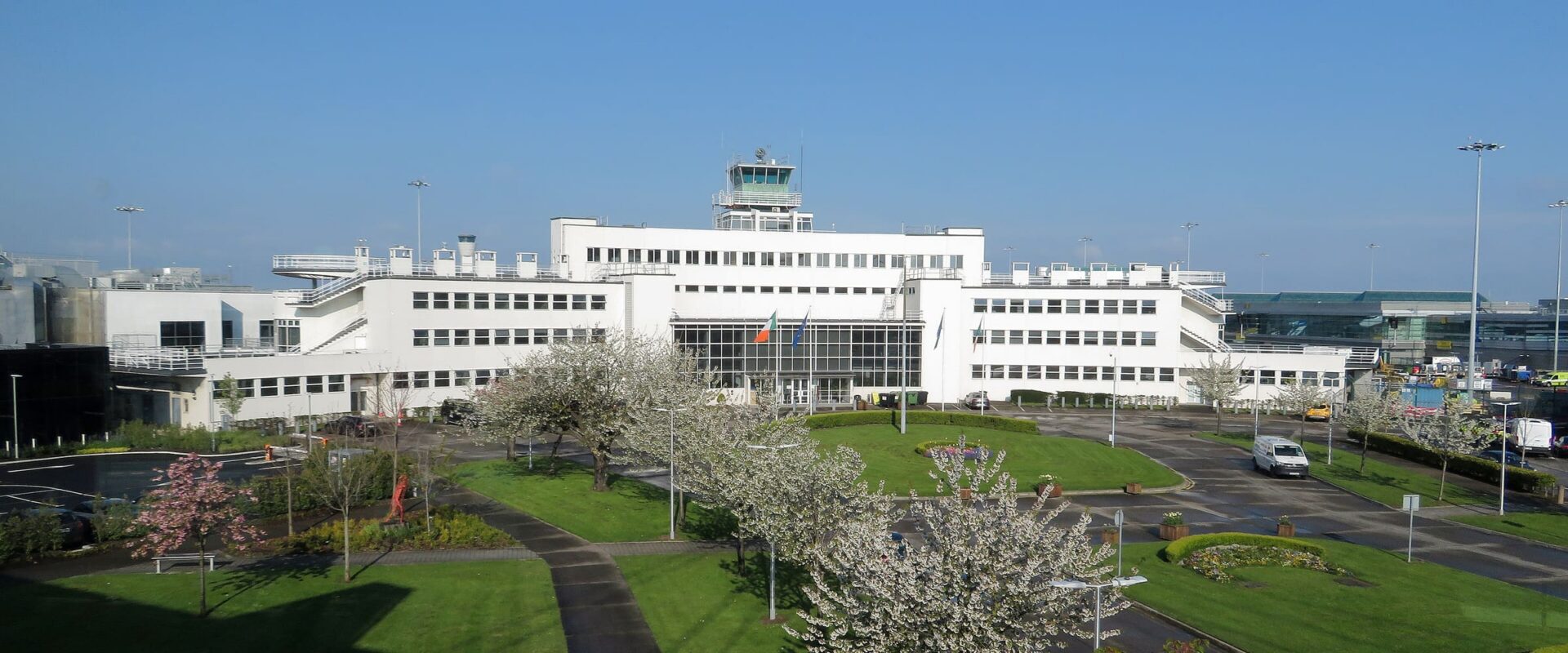
The first terminal at Dublin Airport was shaped like an ocean liner
The white 1940s terminal was designed by Desmond FitzGerald with curved tiers that echo an ocean liner. He was the elder brother of Garret FitzGerald, later Taoiseach. The building once housed one of Dublin’s best restaurants, the Collar of Gold.
Picture at the top of this page: Original terminal building at Dublin Airport, by Gareth James, licensed CC BY-SA 2.0, via Wikimedia Commons. Cropped.
Weather
Weather at Dublin Airport
What the weather is usually like for flying at Dublin Airport, and where to see it live.
Typical flying weather at Dublin
Met Éireann records for 1991 to 2020 show a mean wind of 10.5 knots at Dublin Airport, gales on about 8 days a year and fog on about 32. The two main runways run east to west, and a third runway can be used when the crosswind passes 20 knots.
How the weather is managed
The crew check the forecast for Dublin Airport and for the other end of your trip before every flight. If conditions look doubtful we tell you early and offer a different time or a nearby airport.
Live Dublin Airport weather
The weather page shows the pilot view (the current airport report and forecast), a plain passenger view for the days ahead and a live rain map. If the flight is cancelled because of the weather, you pay nothing.
Weather Dublin Airport: pilot view, passenger view and rain map
Questions
Dublin Airport: your questions answered
What are the opening hours of Dublin Airport?
Where is the private terminal at Dublin Airport?
How early should I arrive at Dublin Airport for a private flight?
Can helicopters land at Dublin Airport?
How far is Dublin Airport from Dublin city centre?
Is there customs and immigration at Dublin Airport?
Related pages
More about Dublin Airport and nearby airports
Flying to or from Dublin Airport?
Tell us the route, the date and how many are travelling. A charter specialist replies with aircraft options and one clear price.
If the flight is cancelled because of the weather, you pay nothing.
Charter-A is a member of the Air Charter Association and is rated 5 stars on Trustpilot.